
How to Spot Strong NFT Demand Before You Buy (Beginner Checklist)
Before buying any NFT, one question matters:
Is there real demand?
Learning how to spot strong NFT demand helps you avoid weak collections, artificial hype, and liquidity traps — especially when you’re still learning how NFT markets actually work.
Before interacting with any NFT marketplace, make sure your wallet is secure. If you haven’t set one up yet, start with one of the best NFT wallets for beginners to protect your assets before buying.
Now let’s break down how to identify real NFT demand using data — not guessing.
What Is NFT Demand?
NFT demand refers to consistent buyer interest within a collection — meaning people are actively purchasing and trading, not just listing NFTs at high prices.
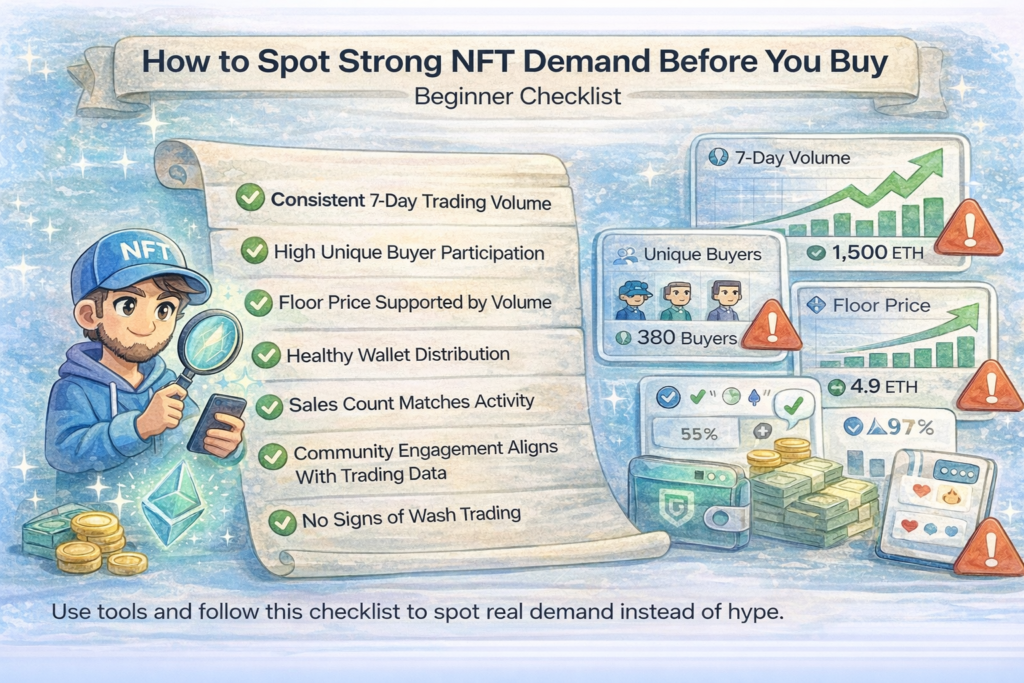
Strong NFT demand usually shows:
- Steady trading volume (not just one-day spikes)
- Multiple unique buyers participating
- Healthy floor price movement supported by sales
- Active community participation that matches the data
Weak demand usually shows:
- Sudden spikes only (hype-driven)
- Very few unique buyers
- Thin trading activity and low sales count
- Floor price not supported by volume
If you’re unfamiliar with volume, start here: what is NFT volume.
And if you’re still learning the fundamentals, see: how to research NFTs before buying.
7 Signs of Strong NFT Demand
1. Consistent 7-Day Trading Volume
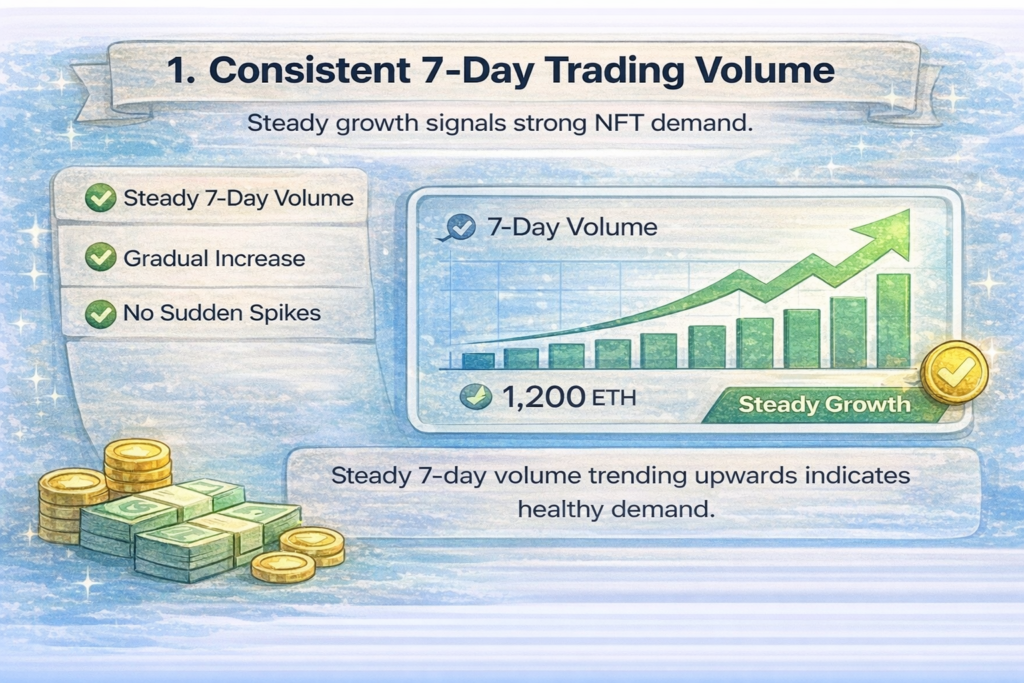
Strong NFT demand is rarely visible in one-day spikes. A single 24-hour pump can be hype, marketing, or wash activity.
Look for:
- Steady 7-day volume
- Gradual increase over time
- No single abnormal surge dominating the chart
If you need to compare demand signals properly, read: how to check NFT floor price.
2. High Unique Buyer Participation
Demand is stronger when many different wallets are buying — not just a small cluster of traders.
Strong collections tend to have:
- Many different buyers (unique wallets)
- Repeated participation from active wallets
- Balanced buy/sell activity (not just constant undercutting)
If only 2–3 wallets dominate trades, demand may be artificial — or liquidity may be controlled by whales.
3. Floor Price Supported by Volume
Floor price is what sellers want. Volume and sales show what buyers will actually pay.
Strong demand often looks like:
- Rising floor + rising volume
OR - Stable floor + consistent volume and sales
Weak demand often looks like:
- Rising floor + falling volume (buyers are disappearing)
To understand the relationship clearly, read: NFT floor price vs volume explained.
4. Healthy Wallet Distribution
Strong demand is more stable when ownership is distributed across many holders rather than concentrated in a few wallets.
Check:
- Top holder percentage
- Whale concentration
- Number of unique holders
Collections with distributed ownership tend to show more consistent buying interest and less manipulation risk.
If you want a structured way to assess holder and project risk, use: NFT due diligence checklist.
5. Sales Count Matches Activity
Don’t confuse listings with sales. Listings show supply. Sales show demand.
Strong NFT demand = actual completed transactions across multiple days.
Low sales despite many listings often means weak buying pressure — and an unstable floor price.
6. Community Engagement Aligns With Trading Data
Strong demand is usually supported by:
- Active Discord
- Organic Twitter/X engagement
- Real conversation (not bots and giveaways only)
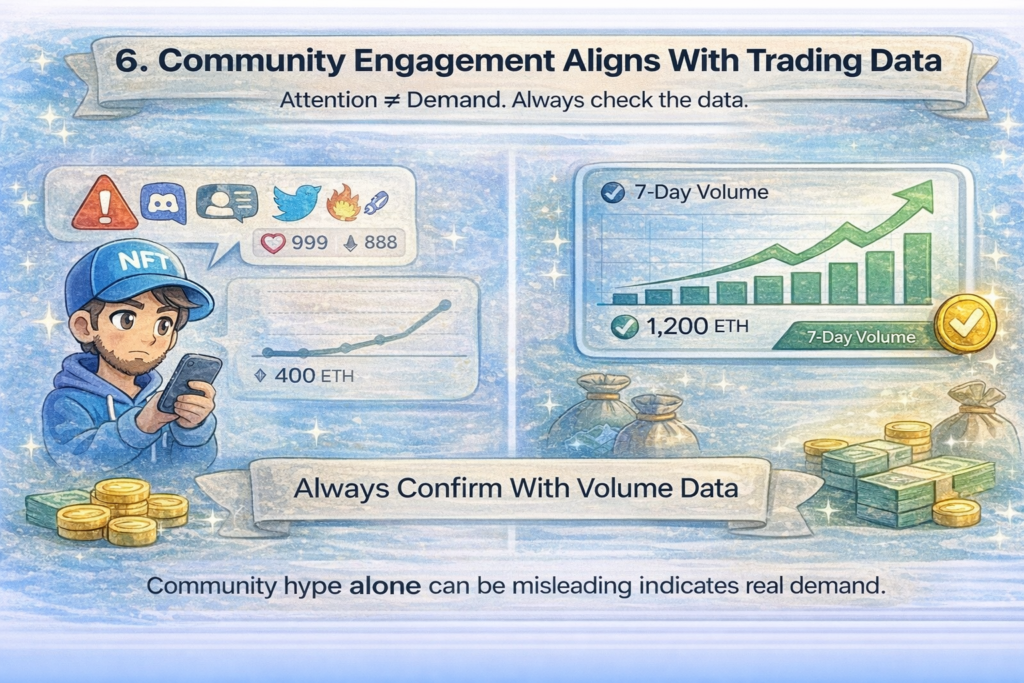
But community hype alone is not proof of demand.
Always confirm with volume, sales count, and unique buyers.
7. No Signs of Wash Trading
Some collections fake demand through repeated trades between the same wallets (wash trading). This can inflate volume and create a false sense of momentum.
Red flags include:
- Same wallets trading repeatedly
- Unrealistic price jumps with no sustained buyer growth
- Extremely high volume without organic community or holder growth
Also be careful where you connect your wallet during research. Understanding how wallet drainers steal NFTs can help you avoid malicious environments.
For marketplace safety, see: how to avoid fake NFT marketplaces.
Beginner Checklist Before Buying
Before purchasing, ask:
✔ Is 7-day volume steady?
✔ Are there multiple unique buyers?
✔ Is floor price supported by volume?
✔ Is ownership distributed?
✔ Is the marketplace legitimate?
✔ Is my wallet secure?
If you’re still learning what happens after a purchase, read: what happens after you buy an NFT.
Tools to Check NFT Demand
To properly spot strong NFT demand, use:
- Official marketplace stats (floor price, volume, sales)
- NFT analytics platforms (trend data and buyer metrics)
- Portfolio trackers (your holdings and performance tracking)
- Blockchain explorers (wallet and transaction verification)
If you want a curated list, see: best NFT tools for beginners.
And for tracking long-term, go here: how to track NFT performance over time.
Common Mistakes When Evaluating NFT Demand
- Trusting social media hype instead of trading data
- Ignoring 7-day trends and focusing on 24-hour spikes
- Buying into sudden volume surges without checking unique buyers
- Not checking wallet distribution and whale concentration
- Skipping due diligence entirely
For a full review framework, use our NFT due diligence checklist and our deeper guide on how to evaluate NFT projects.
Final Thoughts
Learning how to spot strong NFT demand helps you:
- Avoid illiquid projects and liquidity traps
- Reduce buying risk with better data
- Make more informed decisions
- Move beyond guessing
NFT markets are volatile. Demand signals won’t guarantee outcomes — but ignoring them increases risk dramatically.
Combine:
- Trading volume
- Sales activity
- Unique buyers
- Wallet distribution
- Floor price trends
- A secure wallet setup
That’s how beginners buy smarter.
And if you haven’t already, lock in wallet basics first: best NFT wallets for beginners.
FAQ
What is strong NFT demand?
Strong NFT demand is consistent buying activity supported by steady trading volume, regular sales, and multiple unique buyers — not just hype or high listings.
Is high floor price proof of demand?
No. Floor price must be supported by volume, sales frequency, and active participation. A high floor with low volume often signals weak demand.
How do you check NFT demand quickly?
Check 7-day volume trends, unique buyer participation, sales count, wallet distribution, and whether the floor price is supported by real activity.
Can NFT demand be faked?
Yes. Wash trading and coordinated hype can inflate volume and create the illusion of demand. Always check unique buyers and sustained trends over time.