
NFT Floor Price vs Volume Explained (What’s the Difference?)
When researching NFTs, two metrics appear constantly:
Floor price
Trading volume
But understanding NFT floor price vs volume properly is critical before making buying decisions.
This guide explains the difference between NFT floor price and volume, how they work together, and how to analyse demand, liquidity, and activity correctly — without relying on hype.
Before using marketplaces or analytics dashboards, make sure your wallet setup is secure. Start here: best NFT wallets for beginners.
If you’re new to floor price, read our guide on how to check NFT floor price first.
👉 How to Check NFT Floor Price (Beginner Guide)
Quick Summary: NFT Floor Price vs Volume
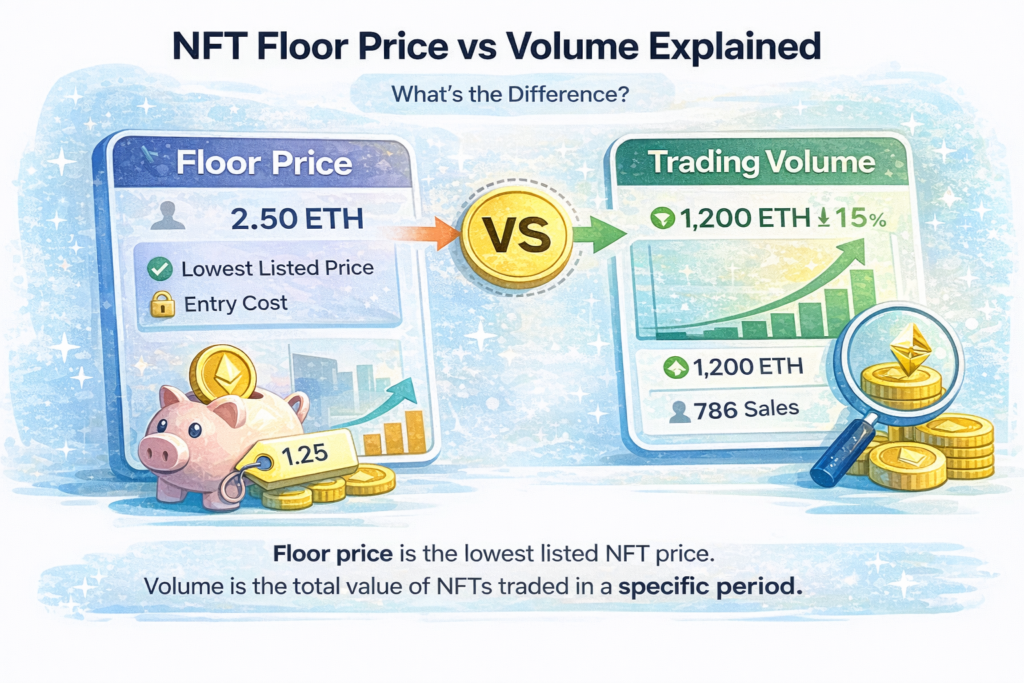
Floor price shows the lowest listing (entry cost). NFT volume shows total traded value (real buying activity) over a time period like 24h or 7d.
For accurate analysis, you should check NFT floor price vs volume together — because floor price alone can be inflated, and volume alone can spike during hype.
If you want a beginner toolkit for tracking these metrics, see: best NFT tools for beginners.
What Is NFT Floor Price?
NFT floor price is the lowest listed price for an NFT in a specific collection.
It represents the minimum entry cost into the project and is based on current listings.
Floor price reflects:
- Current listings
- Seller expectations
- Entry barrier (minimum buy-in)
However, floor price does not show how many people are buying — which is why you must compare it against trading volume.
For a full definition, see our article on what is a floor price in NFTs.
What Is NFT Volume?
NFT volume (or NFT trading volume) refers to the total value of NFTs traded within a specific time period, usually 24 hours or 7 days.
Volume reflects:
- Buyer activity
- Market demand
- Liquidity (how easily items sell)
- Sales frequency
To understand this deeper, read our guide on what is NFT volume.
👉 What Is NFT Volume? (Beginner Guide)
NFT Floor Price vs Volume: The Key Differences
| Metric | Floor Price | Volume |
|---|---|---|
| Shows | Lowest listing | Total traded value |
| Indicates | Entry cost | Demand & activity |
| Changes When | Listings update | Sales occur |
| Measures | Seller pricing | Buyer participation |
This comparison highlights why analysing NFT floor price vs volume together is essential for measuring real demand and avoiding misleading signals.
Why Floor Price Alone Can Be Misleading
Floor price can rise even when there are very few sales. That’s why you should always cross-check floor price with NFT trading volume.
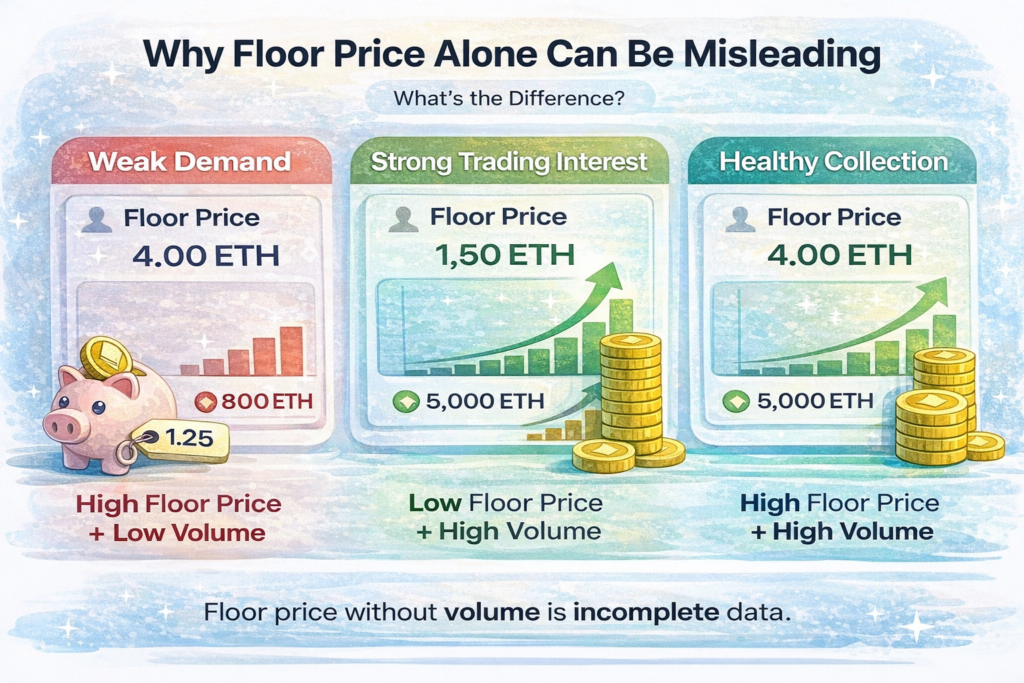
High floor price + low volume = weak demand / thin liquidity
Low floor price + high volume = strong trading interest
High floor price + high volume = healthier collection activity
Floor price without volume is incomplete data.
Why Volume Without Floor Price Is Also Incomplete
Volume spikes can happen during hype cycles, influencer pushes, or short-term mint events.
Without checking floor price:
- You may enter at inflated levels
- You may misjudge sustainability
- You may mistake short-term momentum for long-term growth
Consistent volume over time is usually more reliable than single-day spikes.
How to Analyse NFT Floor Price vs Volume Properly
Step 1: Check 24-Hour Volume
Look for steady activity and meaningful sales count — not just a sudden volume spike.
Step 2: Compare 7-Day Trends
Consistency is usually stronger than volatility. Compare 24h volume against the 7d pattern to avoid being misled by one-day hype.
Step 3: Check Floor Price Movement
Is the floor rising alongside volume, or is the floor rising while volume falls? That difference matters when measuring demand.
Step 4: Verify Marketplace Authenticity
Always use official platforms to avoid scams. See our guide on how to avoid NFT scams and how to avoid fake NFT marketplaces.
Real Example Scenario
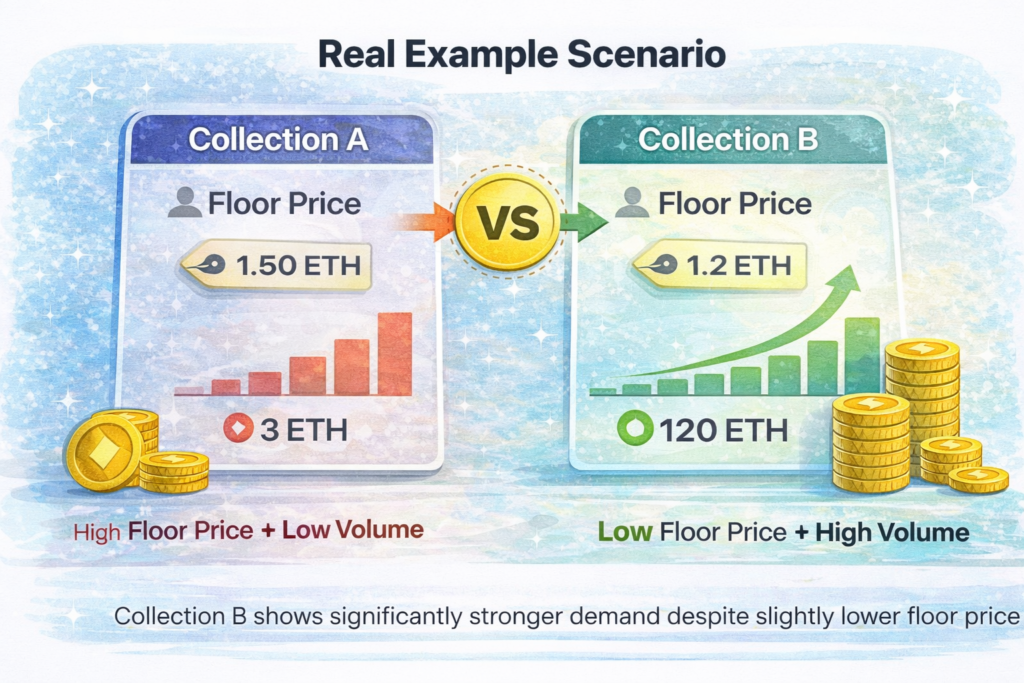
Collection A:
- Floor: 1.5 ETH
- 24h Volume: 3 ETH
Collection B:
- Floor: 1.2 ETH
- 24h Volume: 120 ETH
Collection B shows significantly stronger demand despite slightly lower floor price — because volume indicates real buying activity.
That’s why understanding NFT floor price vs volume matters.
Common Beginner Mistakes
- Confusing volume with listing count
- Ignoring timeframe (24h vs 7d vs total)
- Not comparing historical trends
- Focusing only on floor price
If you’re unsure how contract approvals can create risk, review our guide on how to revoke smart contract approvals safely.
Final Thoughts
Understanding NFT floor price vs volume gives you a clearer picture of:
- Demand strength
- Market health
- Liquidity
- Risk level
Before buying, always:
✔ Check floor price
✔ Check volume
✔ Check trend consistency
✔ Use trusted analytics tools
✔ Secure your wallet properly
If you haven’t already, use one of the best NFT wallets for beginners before interacting with NFT marketplaces or signing transactions.
FAQ Section (Enable FAQ Schema)
What is the difference between NFT floor price and volume?
Floor price is the lowest listed NFT price (entry cost). Volume is the total value of NFTs traded within a time period (real buying activity).
Is high NFT volume good?
Generally, yes. Higher NFT trading volume suggests stronger demand and liquidity, but it should be compared with floor price and sales count.
Can floor price rise without volume?
Yes. Floor price can rise from listings changing, but without volume it may indicate weak buying activity.
Should I check floor price or volume first?
Check both together. Floor price shows entry cost, and volume confirms real trading activity.