
How to Check NFT Floor Price (Beginner Guide)
How to Check NFT Floor Price (Beginner Guide)
If you’re buying, selling, or researching NFTs, one of the first metrics you’ll see is the floor price.
How to check NFT floor price properly matters because the floor price is often the “headline” number people use to judge a collection — even though it can be misleading without volume and sales context.
Before you start tracking floor price, make sure your wallet setup is secure. If you haven’t already, read our guide to the best NFT wallets for beginners (especially if you plan to connect your wallet to marketplaces or analytics tools).
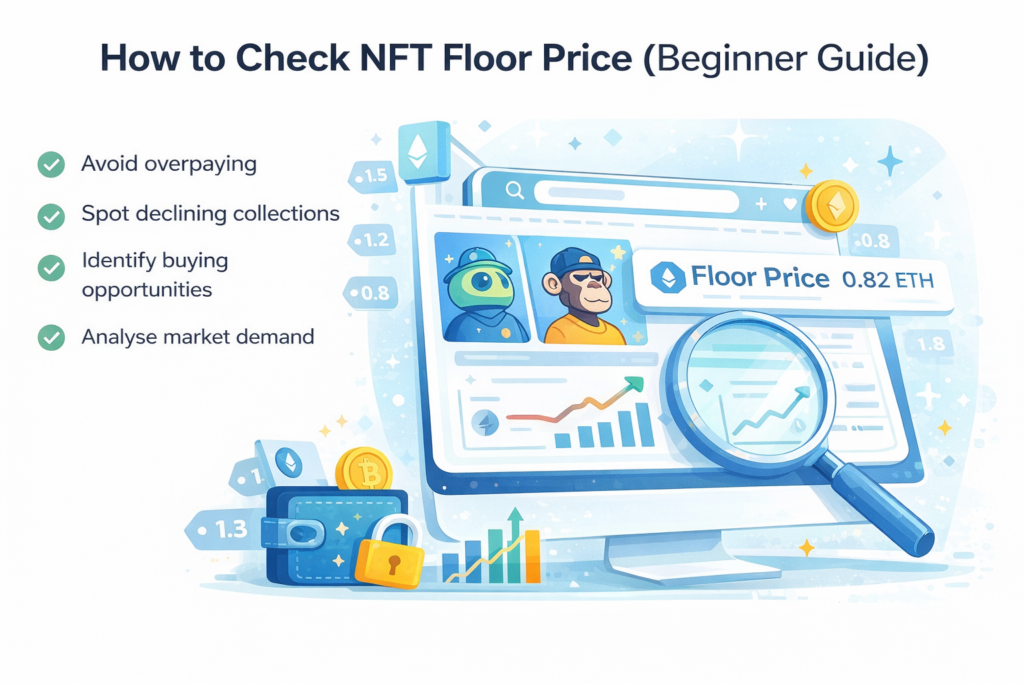
Understanding how to check NFT floor price can help you:
- Avoid overpaying
- Spot declining collections
- Identify potential entry points
- Analyse market demand
This guide explains what NFT floor price means, how to check NFT floor price accurately, and what to look at alongside floor price so you don’t get trapped by misleading listings.
If you’re new to NFTs, you may also want to read what happens after you buy an NFT to understand how ownership, listings, and marketplace activity work.
Quick Checklist: How to Check NFT Floor Price Safely
If you want to check NFT floor price without getting misled, run through this checklist:
- Confirm you’re on the official marketplace (avoid phishing clones)
- Verify the collection contract address when possible
- Check if the floor listing is an outlier (damaged metadata, rare traits excluded, “junk” listings)
- Compare floor price with volume and recent sales
- Use a reputable analytics tool for the floor price chart and trend history
For scam prevention, see how to avoid NFT scams and how to avoid fake NFT marketplaces.
What Is NFT Floor Price?
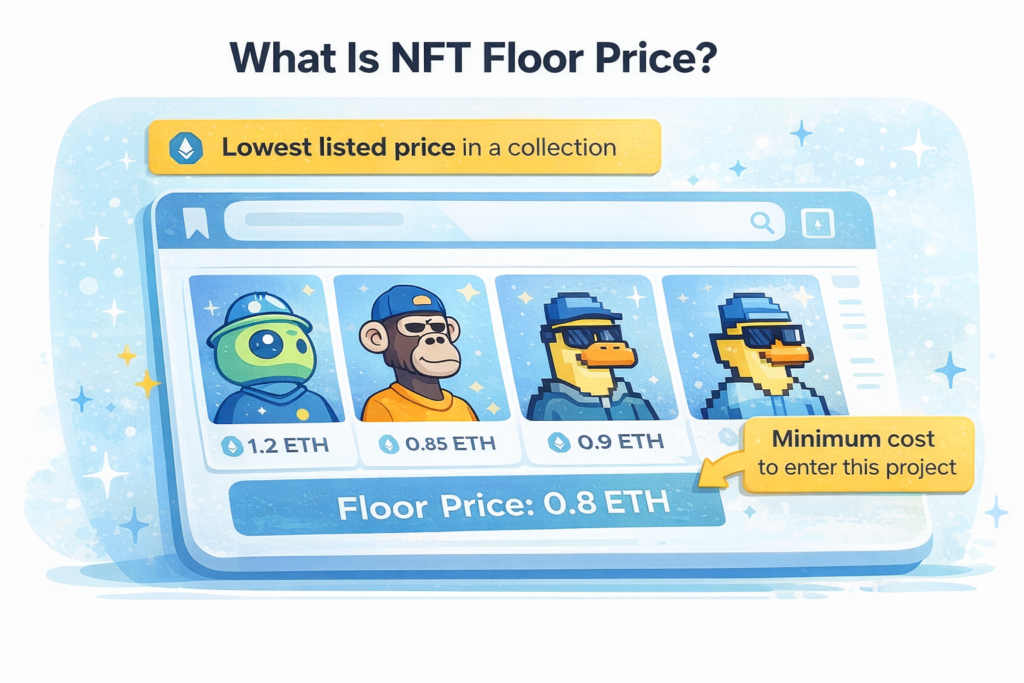
NFT floor price is the lowest listed price for an NFT in a specific collection on a marketplace.
It represents the minimum entry cost into that project based on current listings — not necessarily what people are actually paying.
For example:
If the cheapest NFT in a collection is listed at 0.8 ETH, the floor price is 0.8 ETH.
Floor price does not guarantee value — it reflects current market listings, and it can be manipulated by thin liquidity or low volume.
If you want a deeper explanation of floor price, see our full guide: what is a floor price in NFTs.
Why Floor Price Matters
Floor price helps you:
- Measure demand (roughly)
- Compare collections
- Track price trends
- Evaluate volatility
However, floor price alone does not show full market strength. To analyse properly, you need volume, sales count, and transaction activity.
To learn the difference, read: NFT floor price vs volume explained.
If you’re serious about NFT research, review our list of the best NFT tools for beginners (analytics, tracking, and safety tools).
How to Check NFT Floor Price (Step-by-Step)
Step 1: Visit the Official Marketplace
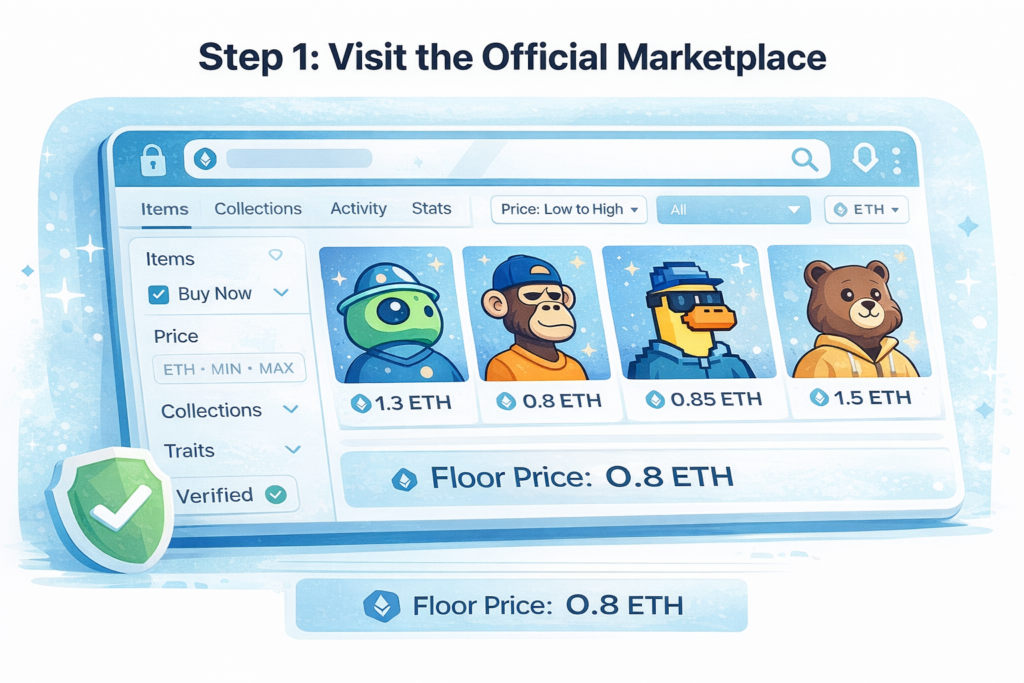
To check NFT floor price, go to the collection’s official marketplace page and locate the floor price metric or the lowest active listing.
Look for:
- “Floor price” label
- Lowest active listing
- Current currency (ETH, SOL, etc.)
Always verify you are on the correct website to avoid phishing attempts. If you’re not sure where to buy safely, see best NFT marketplaces for beginners.
Step 2: Use NFT Analytics Platforms
NFT analytics platforms help you check NFT floor price more accurately by showing:
- Historical floor price charts
- Volume data
- Sales history
- Holder statistics
These tools help you understand trends beyond just the lowest listing. If you also want to track performance over time, see how to track NFT performance over time.
Step 3: Analyse Volume and Sales Activity
Floor price without volume is misleading.
Check:
- 24-hour trading volume
- Number of sales
- Recent transaction frequency
If volume is low, floor price may not reflect strong demand. To understand this properly, read what is NFT volume and floor price vs volume explained.
Step 4: Compare Floor Price Over Time
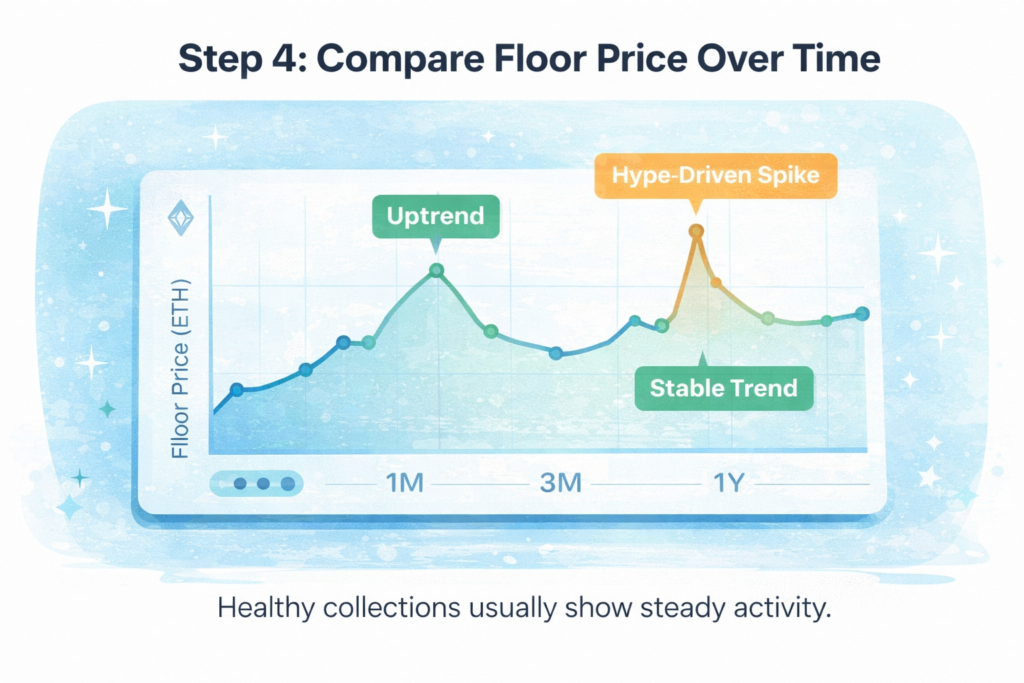
When you check NFT floor price, don’t just look once. Compare floor price over time to see if the collection is trending up, fading, or simply volatile.
Look for:
- Uptrend consistency
- Sharp spikes (often hype-driven)
- Long-term stability
Healthy collections usually show steady activity and a floor price chart that matches sales volume.
Common Mistakes When Checking NFT Floor Price
- Confusing floor price with average sale price
- Ignoring trading volume and sales count
- Trusting unofficial tracking sites
- Not verifying the marketplace or collection contract address
If you’re unsure how contract risks work, read what is a malicious smart contract and NFT security checklist for beginners.
Is a Low Floor Price a Good Buy?
Not necessarily.
A low floor price may mean:
- Weak demand
- Project decline
- Oversupply
Always combine floor price with:
- Floor price trend (over time)
- Volume and sales activity
- Community engagement
- Roadmap credibility and project fundamentals
If you want a practical framework for project analysis, use how to evaluate NFT projects and NFT due diligence checklist.
Final Thoughts
Learning how to check NFT floor price correctly helps you make informed decisions — but don’t rely on one metric.
Use:
- Trusted marketplaces
- Analytics tools and floor price charts
- Volume and sales activity
- Secure wallet setup
If you haven’t yet, make sure you’re using one of the best NFT wallets for beginners before connecting to NFT marketplaces or analytics platforms.
FAQ Section
What does NFT floor price mean?
NFT floor price is the lowest listed price for an NFT in a specific collection on a marketplace.
Is floor price the same as value?
No. Floor price reflects listings, not necessarily long-term value or average sale price.
How often does NFT floor price change?
It changes whenever listings are added, removed, or purchased — so it can shift many times per day on active collections.
Can floor price predict future value?
No. NFT floor price is a snapshot of current listings, not a forecast of future performance.